Countertop Materials for Jersey Shore Homes: Granite, Quartz, Quartzite and More Compared

Choosing a countertop is one of the most practical decisions in any kitchen or bathroom remodeling project, and at the Jersey Shore it comes with a few extra variables. Homes here contend with humidity, salt air, strong ocean-facing sunlight, and the temperature swings of a house that may be closed up for part of the year. Just as important is how you and your family actually use the space day to day. This article lays out the honest advantages and drawbacks of the countertop materials we fabricate and install most often, so you can weigh them against your own priorities.
Why Jersey Shore Homes Ask More of a Countertop
Coastal conditions are harder on interior surfaces than inland conditions. Salt air holds moisture against every surface it touches, and elevated humidity slows drying. Ocean-facing windows can put direct sunlight on a countertop for hours at a stretch, which matters for materials whose color can shift under prolonged UV exposure. Homes that sit closed up between visits also go through wider swings in temperature and humidity than a house that is occupied and climate-controlled year round. Whether yours is a year-round residence in Lower Township or a second home in Avalon, those conditions belong in the conversation before you choose a slab.
Start With How You Use the Space
Two homeowners can look at the same slab and reach opposite conclusions, and both can be right. If you cook seriously and routinely move cast iron from a burner to the counter, the heat tolerance of natural stone is worth a great deal. If you rarely cook but enjoy red wine, coffee, and citrus, a non-porous surface that will not absorb an overnight spill may matter more than heat resistance. Households with young children often prioritize forgiving, low-maintenance surfaces and eased edge profiles, while an adult household that entertains may happily accept a more delicate stone in exchange for the look it wants.
Entertaining patterns matter too. A kitchen that hosts twenty people over a holiday weekend takes more abuse than one that serves two. Baking, canning, large-format prep, and how much of the counter doubles as a landing zone for groceries and beach gear all push the decision in different directions. Bring those habits to the showroom with you — they narrow the field faster than any general rule.
Quartz Countertops: Advantages and Drawbacks
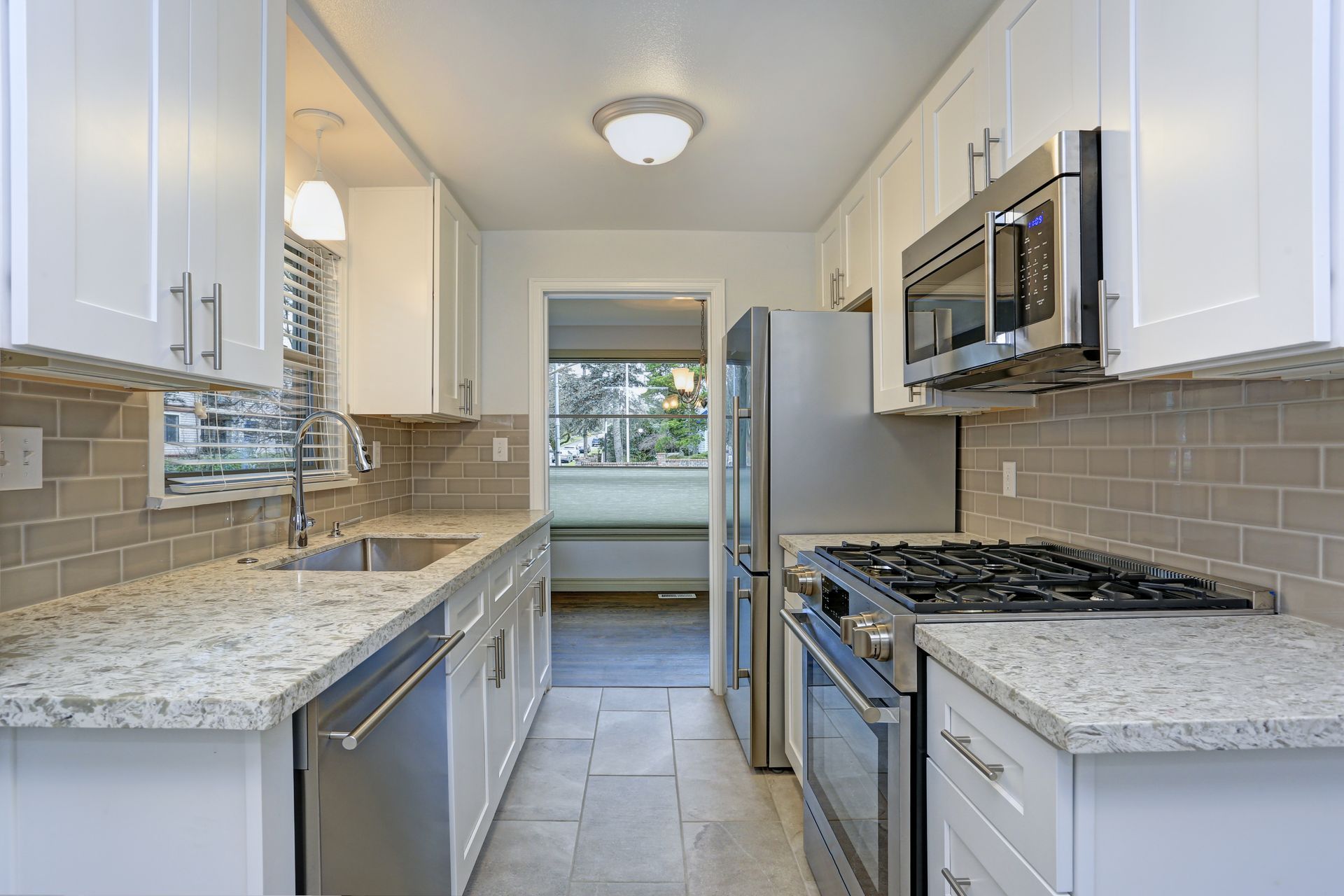
Quartz is an engineered surface, roughly 90 percent ground natural quartz bound with resins and pigment. Because it is non-porous, it never needs sealing and resists staining from wine, oil, and citrus, and it gives moisture nowhere to go — a genuine advantage in a humid coastal home. Color and pattern are consistent from slab to slab, so what you approve in the showroom is what gets installed, and the range of solid, veined, and marble-look patterns is enormous.
The resin binder is also the source of quartz's limitations. It is less heat resistant than natural stone: a hot pan set directly on the surface can scorch, discolor, or in some cases crack it, so trivets are not optional. Prolonged direct UV exposure can cause some quartz colors to fade or yellow, which is worth discussing if a run of counter sits under a large south- or west-facing window; a handful of manufacturers make UV-stable lines for sun-drenched and outdoor applications. Quartz also cannot be refinished the way stone can, seams tend to be more visible than in busy natural stone, and premium marble-look patterns sit at the top of the price range.
Granite Countertops: Advantages and Drawbacks
Granite is quarried natural stone, and every slab is one of a kind — for many homeowners that is the entire appeal. It is very hard, stands up well to everyday scratching and chipping, and it handles heat better than any engineered surface, which is why cast iron cooks and canners frequently prefer it. It can be repaired and re-polished by a fabricator rather than replaced, and mid-range granites remain among the best values per square foot in natural stone.
Granite is porous, so it needs to be sealed to resist staining from oil, wine, and other spills; an under-sealed top can absorb a spill and darken. Pattern and movement vary from slab to slab, which means granite should be selected in person rather than from a small sample. Some of the more dramatic exotic granites carry natural fissures and pitting that read as flaws to some buyers, and a very busy pattern can compete with a heavily patterned backsplash or floor.
How Often Does Granite Need to Be Sealed at the Jersey Shore?
With a standard impregnating sealer, most granite benefits from resealing every one to two years, and coastal humidity is a good reason to check it at the shorter end of that range — leave a few drops of water on the surface for several minutes and you will see whether the stone is still repelling moisture. If you would rather not think about it at all, we also offer a 25-year Dry-Treat sealer as an add-on at fabrication. It is applied in our shop, carries a long-term warranty, and is the option most of our granite customers choose over a yearly maintenance product, particularly in homes that are not occupied every week of the year.
Quartzite Countertops: Advantages and Drawbacks
Quartzite is natural stone that often reads like marble — soft veining over a light background — while behaving much more like granite. True quartzite is extremely hard, frequently harder than granite, resists scratching, and etches far less readily than marble, and shares natural stone's tolerance for heat. For homeowners who want the look of a white marble without its fragility, quartzite is usually the closest honest answer, and it has become one of the most requested materials in our showroom.
Like granite, quartzite is porous and needs to be sealed, and the same 25-year Dry-Treat option is available on it. It sits at the higher end of the price range for both material and fabrication, since its hardness is demanding on tooling. It is also worth knowing that some slabs sold in the market as quartzite are actually softer dolomitic marble, which will etch; we identify what we are selling so you know which behavior to expect from your slab.
Marble Countertops: Advantages and Drawbacks
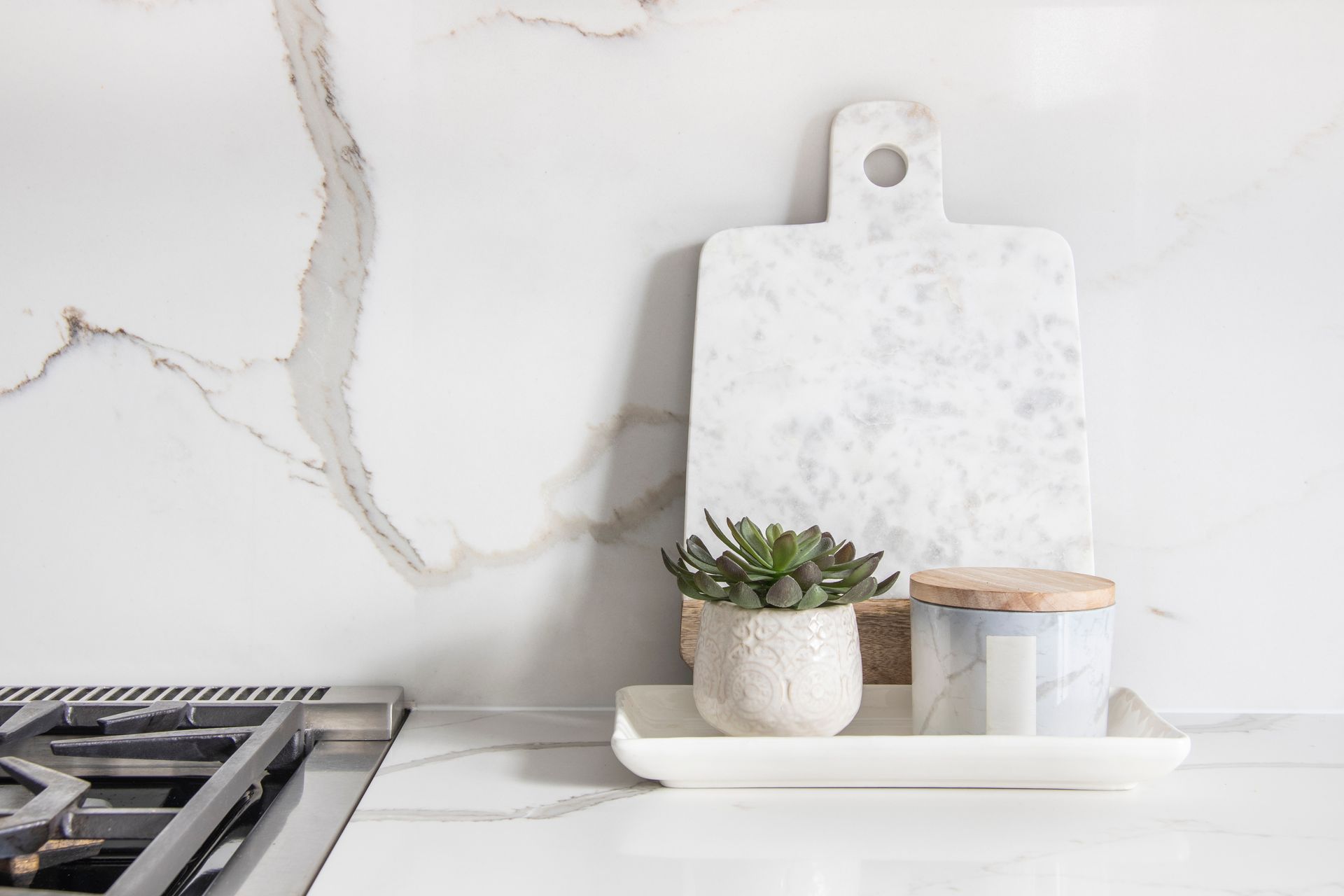
Nothing else looks quite like marble, and for a certain kind of coastal kitchen or a bathroom vanity it is simply the material. It is also naturally cool to the touch, which bakers value for pastry work, and it can be honed or re-polished. The trade-offs are real: marble is porous and comparatively soft, and it etches on contact with anything acidic — lemon, vinegar, wine, tomato, some household cleaners. Etching is a chemical reaction rather than a stain, so no sealer prevents it. Many marble owners come to see the resulting patina as part of the material's character, while homeowners who want a surface to look new in year ten are usually happier elsewhere. Marble is often the right call on a powder-room vanity even when it is the wrong call on a working kitchen island.
Butcher Block: Advantages and Drawbacks
Wood brings warmth and a relaxed, comfortable feel that stone cannot replicate; it is easy on knives, and it can be sanded and refinished in place. Of every material here, it asks the most of its owner: butcher block needs periodic oiling, standing water around a sink cutout will eventually cause staining, swelling, or cracking, and coastal humidity makes consistent upkeep more important rather than less. It tends to work best as an accent — an island section, a coffee bar, a baking station — paired with stone or quartz in the wet and hot zones.
Bathroom Vanity Tops: A Slightly Different Calculation
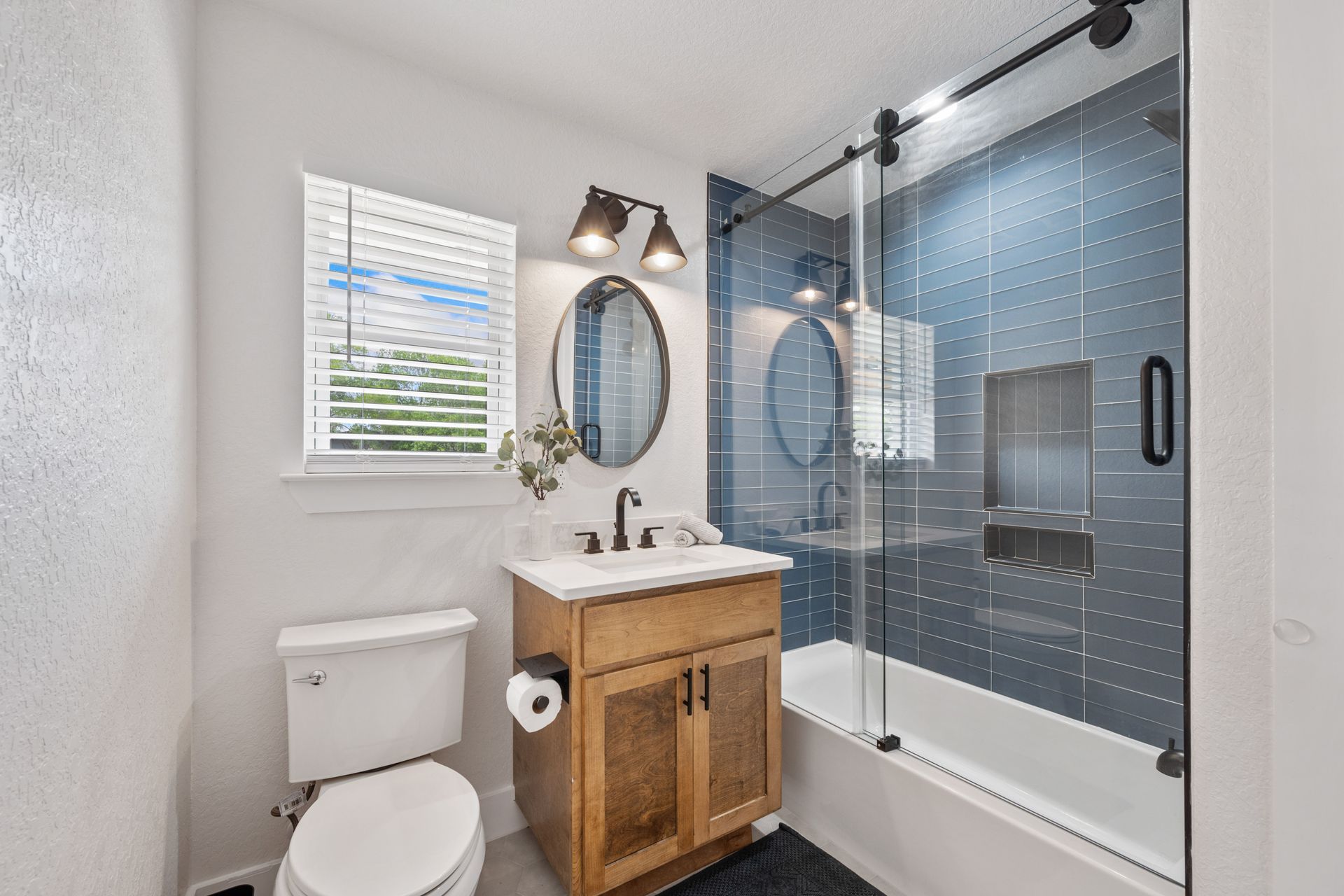
We fabricate and install vanity tops as well as kitchen counters, and bathrooms change the calculation. Heat is rarely the issue; standing water, toothpaste, cosmetics, hair products, and cleaning chemicals are. That leads many homeowners toward quartz in a primary or children's bathroom, where a non-porous surface shrugs off the daily mess. At the same time, a vanity is a small enough surface that a more expensive or more delicate stone becomes attainable — a marble or quartzite remnant that would be out of reach across a full kitchen is very achievable on a 37-inch vanity top.
Bathrooms are also where sink style drives material and edge decisions: undermount, vessel, and integrated sinks each pair with different thicknesses and details. Working at that scale makes it practical to mix materials across a house — quartz in the main kitchen, quartzite on the island, marble on the powder-room vanity.
Ready to Compare Countertops for Your Jersey Shore Home?
Based in Cape May Court House, Quality Home Center provides kitchen and bathroom remodeling, countertop fabrication, and professional installation for homeowners across the Jersey Shore, including Cape May, West Cape May, Cape May Point, Wildwood Crest, Wildwood, North Wildwood, Stone Harbor, Avalon, Sea Isle City, Strathmere, Ocean City, Upper Township, Lower Township, and Middle Township. Visit the home remodeling services page to learn more, or reach out through the contact page to start a conversation about your project.
Every household uses its space differently, and the right countertop is the one that fits how you live. Bring your plans, your habits, and your questions to our Cape May Court House showroom on Route 9, where you can see full slabs in person and compare materials side by side — open Monday through Saturday, or call (609) 465-5029.
Recent Posts